
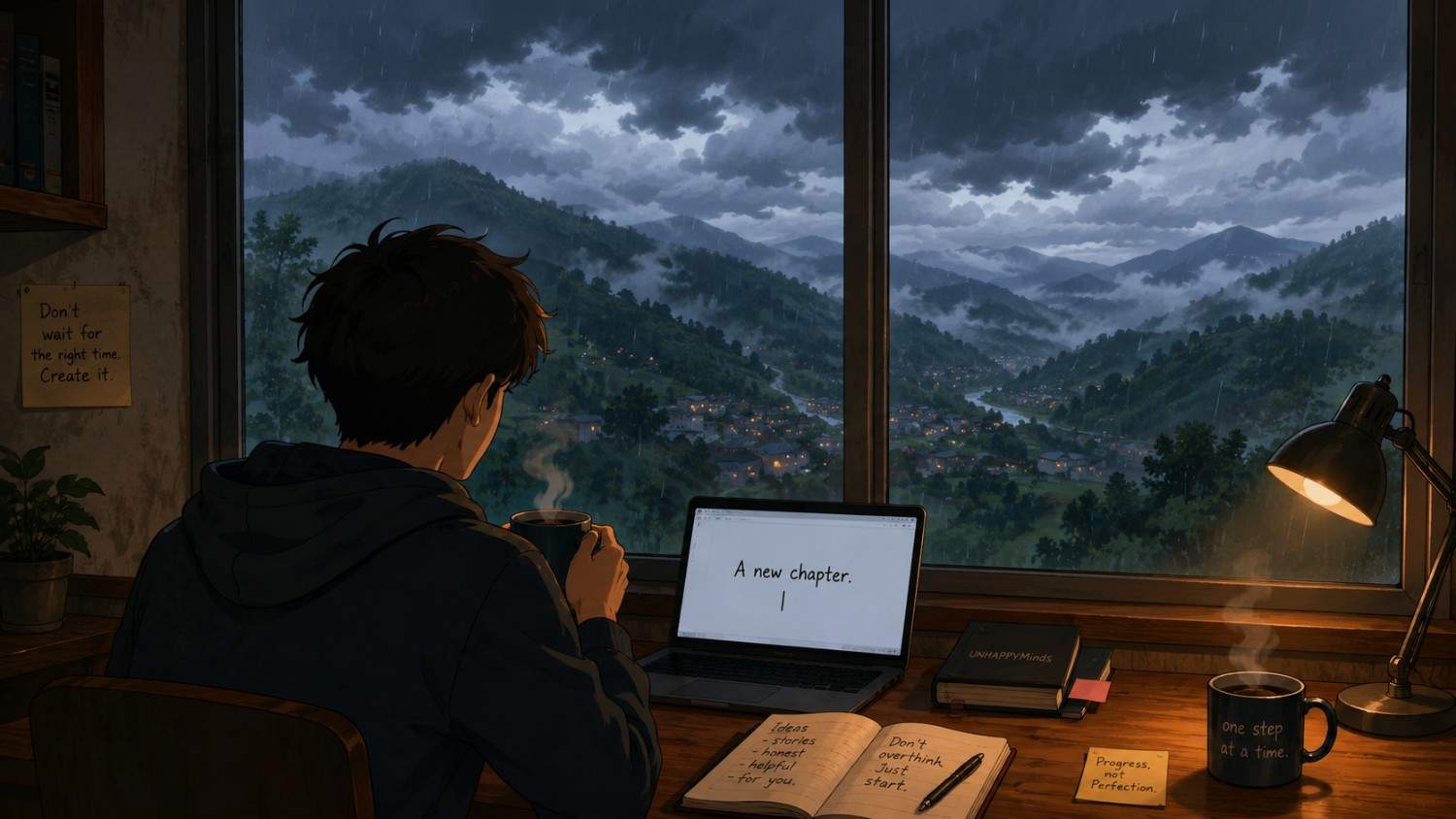
(Or maybe… I finally stopped waiting inside it.)
To reach somewhere, you have to leave somewhere.
I had heard that line so many times growing up that it had eventually become one of those sentences adults casually throw around — like “Health is wealth” or “Money can’t buy happiness.”
Wise enough to nod at, but never interesting enough to actually think about.
Back then, I assumed it meant only one thing.
Leave your hometown. Move to a bigger city. Find a better life. Simple.
At least, that was what everyone around me seemed to believe.
Funny how life waits for the right moment to change the meaning of an old sentence.
Years later, sitting in the same room where time had almost forgotten me…
I finally understood it.
Sometimes, leaving doesn’t mean changing cities.
Sometimes, it means leaving behind the version of yourself that has been waiting for life to begin.
Leaving Doesn’t Always Mean Leaving
Back then, my world hadn’t changed much since I last wrote about it.
The same room. The same wooden table. The same laptop that had somehow become my office, classroom, entertainment system, and therapist — all at once.
Outside my window, the hills stood quietly beneath the morning mist.
Some mornings, the clouds drifted so low that it looked as though they had come down just to rest for a while.
I used to wonder…
Maybe even clouds get tired of moving.
Maybe that’s why they stop here.
Then I’d laugh at myself.
Overthinking the weather was apparently my newest hobby.
When you’re unemployed for long enough, your brain starts hosting conversations nobody invited it to.
The room still carried the same silence.
Not the peaceful kind.
The kind that slowly settles into your routine until you stop noticing it.
The ceiling fan still made that irritating clicking sound every few minutes, as though it wanted to remind me that it was working harder than I was.
The Wi-Fi still disconnected exactly when I needed it most.
And the tea on my desk still went cold because I had a terrible habit of thinking too much before taking the next sip.
Some things never change.
Some things refuse to.
When Waiting Became My Routine
Every morning followed almost the same script.
Wake up.
Brush.
Make chai.
Open the laptop.
Open Gmail.
Refresh.
Nothing.
Open LinkedIn.
Scroll.
Apply.
Close it.
Refresh Gmail again…
Just in case the internet had suddenly decided to reward my patience.
Spoiler: It never did.
Sometimes, I refreshed Gmail so many times that I started feeling guilty.
As though I was disturbing it.
“Arre bhai… kuch hoga toh bata hi denge.”
Then came the outside world.
It always arrived on time.
Sometimes in the form of relatives.
Sometimes neighbours.
Sometimes family friends who somehow knew everything about everyone—
except how to mind their own business.
“Beta… job ka kuch hua?”
“Abhi bhi ghar pe ho?”
“Koi exam de rahe ho?”
“Private dekh rahe ho ya government?”
One question, then another, then another.
It wasn’t an interrogation but somehow, it always felt like one.
At first, I answered honestly then I shortened my answers. Eventually, I perfected the art of smiling.
“Bas… try kar raha hoon.”
Those four words became my full-time job.
People often say, “They’re just concerned.”
Maybe. Some probably were. But concern has a strange habit. When it arrives every week, it starts sounding a lot like judgment.
Not because people are cruel. Most aren’t.
They simply don’t realise that the same question, asked by twenty different people, doesn’t feel like concern anymore. It feels like a reminder. A reminder of everything you already think about before falling asleep.
Slowly, without even realising it, I stopped going out.
Not completely. Just enough. Enough to avoid unnecessary conversations. Enough to reduce the chances of hearing —
“Arre, tu toh bada ho gaya!”
followed immediately by —
“Waise aajkal kar kya raha hai?”
It’s funny.
Nobody asks what you’re reading. What you’re learning. What keeps you awake at night.
Or whether you’re okay.
Life gets reduced to one sentence:
“So… what do you do?”
And when you don’t have an answer people understand, it is almost as though you disappear.
I even stopped attending weddings. Not because I disliked them. I actually loved weddings. The lights. The music. Children running around for no particular reason. That one uncle who danced as though tomorrow wasn’t real. Unlimited gulab jamuns.
What wasn’t there to like?
But somewhere along the way, weddings stopped feeling like celebrations.
They started feeling like interviews. Different decorations. Different buffet.
And same questions —
“Beta, job lag gayi?”
“Package kitna hai?”
“Ab tumhari baari kab hai?”
Every smile felt rehearsed.
Every answer sounded borrowed.
Every conversation somehow found its way back to my career.
By the time dessert arrived, I usually wanted to go home.
So eventually, whenever an invitation came, I politely declined.
“Sorry… thoda kaam hai.”
It was a lie.
Not a dramatic one.
Just the kind you tell to protect whatever little peace you have managed to collect.
The strange thing about staying home for too long is that the room slowly stops feeling like a room.
It becomes your entire world.
Days begin and end without anything memorable happening.
Monday looks suspiciously similar to Thursday.
Sunday feels exactly like Tuesday.
Time doesn’t stop. It simply forgets to leave footprints.
I don’t know how many afternoons I spent sitting beside the window with a cup of chai, watching the road disappear into the hills.
People came. People left. Tourists stopped to take pictures. Children walked home from school. Buses climbed the winding roads.
Delivery riders somehow found addresses that even Google Maps struggled with.Everyone seemed to be going somewhere.
Except me.
The Evening I Finally Understood
One evening, it had rained just enough to leave the familiar smell of wet mitti hanging in the air.
The hills looked greener than usual.
Clouds had wrapped themselves around the mountains so tightly that the entire valley looked as though it had fallen asleep beneath a white blanket.
I took my chai to the rooftop.
Mostly because the room had started feeling smaller than my thoughts.
The wind was cool.
Almost cold.
The kind that makes you pull your sleeves over your hands without even noticing.
Far away, a small bus was slowly climbing the road carved into the hillside.
I kept watching it.
Not because buses are particularly fascinating.
But because it was moving.
Slowly.
Patiently.
One bend at a time.
No shortcuts.
No drama.
No hurry.
Just moving.
And for reasons I still can’t fully explain, I suddenly thought —
If that bus decided to stay where it was, it would never reach the top.
It wouldn’t matter how powerful its engine was.
It wouldn’t matter how beautiful the destination looked from below.
It had to leave one place to reach another.
That was when the old sentence quietly returned.
“To reach somewhere, you have to leave somewhere.”
For the first time, it wasn’t talking about cities.
It was talking about me.
Maybe I didn’t need to leave my hometown.
Maybe I needed to leave behind the version of myself that had confused waiting with progress.
Because refreshing Gmail wasn’t movement.
Overthinking wasn’t movement.
Imagining a better future wasn’t movement.
They were all different ways of standing still.
I finished the last sip of chai.
It had gone cold.
But for the first time in months, something inside me hadn’t.
I stood there for a while, watching the little bus disappear behind the mountains.
Then I smiled.
Not because life had changed.
It hadn’t.
Not because I suddenly knew what to do.
I didn’t.
But somewhere between the mist, the mountains, and a cup of slightly overboiled chai, a very small part of me had finally decided —
Tomorrow, I would stop waiting.
And maybe…
just maybe…
take the first step.
The Morning I Closed Gmail
The next morning, nothing looked different.
The mountains hadn’t suddenly become brighter.
The birds hadn’t started singing inspirational songs.
And unfortunately, my Gmail inbox was still as empty as my wallet.
Life has a funny habit of refusing to change overnight, even after you’ve had a big, life-changing realisation.
The world doesn’t care that you have finally decided to get your life together.
Monday still feels like Monday.
The dishes still need washing.
And the Wi-Fi still disconnects at the worst possible moment.
I sat in front of my laptop.
Out of habit, my fingers moved towards Gmail.
Refresh.
Then LinkedIn.
Then back to Gmail.
I stopped halfway.
Closed both tabs.
And opened a blank page instead.
The cursor blinked patiently.
Almost as though it had been waiting longer than I had.
For a few minutes, I simply stared at it.
Funny how starting something new can feel scarier than staying stuck.
The blank page wasn’t judging me.
I was.
I didn’t know exactly what I wanted to build.
I only knew that I was tired of spending my entire day waiting for somebody else to give me permission to move forward.
So I started writing.
Technology had always fascinated me.
Not in the “I built the next unicorn startup” kind of way.
I simply enjoyed figuring out why something worked.
Or why it didn’t.
I could spend hours reading documentation that most people avoided like vegetables on a dinner plate.
I’d break the code.
Fix it.
Break it again.
Google the error.
Copy a solution.
Realise it didn’t work.
Then somehow solve the problem by changing one tiny line I didn’t even remember touching.
Programming has a strange way of making you feel incredibly smart and unbelievably stupid — sometimes within the same five minutes.
Maybe that was why I liked it.
It reminded me of life.
The first article took almost an entire day.
Not because it was long.
Because I kept rewriting the opening paragraph.
Delete.
Rewrite.
Delete again.
Make chai.
Come back.
Read it.
Hate it.
Repeat.
At one point, I genuinely wondered whether becoming a monk would be easier than writing an introduction.
Eventually, I stopped trying to make it perfect.
And clicked —
Publish.
Nothing happened.
No notifications.
No comments.
No email saying —
“Congratulations! The internet has been waiting for this masterpiece.”
Just silence.
I laughed and closed the laptop.
And for the first time in months, that silence didn’t bother me.
Because it wasn’t empty anymore.
Something I had created was sitting inside it.
The next day, I wrote again.
Then again.
Some days, I published.
Some days, I simply learned.
Some days, I spent six hours fixing one tiny bug that eventually turned out to be a missing semicolon.
I wish I were joking.
Slowly, my days stopped revolving around waiting.
Instead of measuring time by how many times I refreshed Gmail, I started measuring it by how much I had learned before dinner.
Somewhere along the way, the question had changed.
It was no longer —
“Will someone hire me?”
It had quietly become —
“What can I build today?”
And strangely, that question felt lighter.
The applications never stopped.
Every evening, after writing or coding for a few hours, I updated my resume again.
Changed one sentence.
Removed another.
Added a new project.
Checked every word twice, as though recruiters secretly rejected people for misspelling “receive.”
Maybe they did.
Who knows?
Then came the familiar routine.
Attach resume.
Click Apply.
Wait.
The waiting still existed.
It just wasn’t the only thing left in my day.
Weeks passed.
The room looked exactly the same.
The wooden table had somehow collected more coffee stains than achievements.
The ceiling fan still complained.
The hills outside still disappeared behind the evening mist.
Nothing around me had changed.
But something inside me had become quieter.
Not happier.
Not confident.
Just less restless.
I had stopped treating every day like an exam result.
Some days were simply days when I learned something new.
For the moment, that was enough.
One Reply
Then, one ordinary Tuesday, my phone buzzed.
I almost ignored it.
I assumed it was another promotional email trying to convince me that I urgently needed a credit card or an online course that would change my life in seven days.
It wasn’t.
It was a reply.
Just a reply.
I opened it twice.
Then a third time.
Mostly because my brain refused to believe it was real.
Someone had read my application.
Someone wanted to know more.
It wasn’t a job offer.
It wasn’t even an interview.
It was simply a conversation.
Funny how hope sometimes arrives wearing very ordinary clothes.
That one email quietly became another.
Then another.
A short discussion.
A simple task.
Nothing impossible.
Nothing glamorous.
Just enough work to make me question every skill I thought I had.
I remember staring at the screen one night and thinking —
“Yaar… agar ye bhi kharab kar diya toh?”
Then I made another cup of chai.
Read the problem again.
Took a breath.
And continued.
Not because I was fearless.
I had simply spent enough time being afraid.
Days turned into weeks.
The conversations continued.
Sometimes they replied within minutes.
Sometimes they took two days.
Those two days felt longer than my engineering degree.
I kept checking my inbox.
Old habits die slowly.
But this time, the waiting felt different.
It wasn’t desperation anymore.
It was curiosity.
Exactly one month later, another email arrived.
This one was different.
No assignment.
No questions.
No feedback.
Just an offer.
There were no violins playing in the background.
No dramatic movie scene.
No slow-motion celebration.
Just a PDF quietly sitting inside an email.
I read it once.
Then again.
Then I checked the sender’s name to make sure it hadn’t been sent to me by mistake.
It hadn’t.
For the first time in what felt like forever, someone somewhere believed I was worth giving a chance.
And honestly, that meant more than the salary written on the last page.
I didn’t tell the world.
There was no LinkedIn post.
No Instagram story.
No dramatic announcement about how hard work had finally paid off.
Just a quiet conversation at home.
I still remember handing my phone to Papa without saying anything.
He adjusted his glasses and read the email.
Then he looked at me.
He didn’t say much.
He never really did.
He simply smiled, folded the newspaper beside him, and asked —
“Chai piyega?”
It was probably the simplest celebration of my life.
Later that evening, Papa came home with a paper bag of hot samosas.
We all sat together over chai.
Nobody said much.
Nobody needed to.
The house felt… lighter.
Not because all our problems had disappeared. They hadn’t. But hope had finally found our address again.
That night, I walked back into the same room. The same table. The same chair. The same fan making that irritating clicking sound. The room hadn’t changed. But it no longer felt like the place where time had frozen.
It had quietly become the place where life had started moving again.
Looking back, I don’t think getting the job was the moment that changed everything.
The real change had happened weeks earlier —
on the morning I closed Gmail, opened a blank page, and decided to create something instead of waiting for something.
Sometimes life doesn’t change all at once.
Sometimes…
the first thing that changes is you.
Let’s Stay in Touch
If this chapter made you pause, smile, or quietly think, “I’ve felt this too,” thank you for reading.
I share new chapters, snippets from everyday life, and the occasional unfinished thought on Instagram.
For shorter reflections (and the occasional random observation), you’ll also find me on X.
Wherever we meet next, I’d love to have you along for the journey.